

TL;DR In a market where conditions shift weekly, and organisations must deliver more with fewer resources, it is time to move beyond traditional delivery models to an AI-agent-driven software development lifecycle (AI-SDLC). This blog explores how human and AI agents collaborate within the AI-SDLC and the benefits this collaboration brings to the enterprise.
Many enterprises are still operating within traditional delivery loops, where even minor changes are delayed by coordination overhead and slow release cycles.
For example, at a recent public sector engagement, mission-critical business logic was locked behind decades-old COBOL code. This created challenges like
High ongoing support costs - 2000+ production batch jobs required deep tribal knowledge to support with minimal existing documentation.
Lagging innovation - Feature development for business initiatives was slow, as tracing decades-old code to understand change impact delayed both design and implementation.
Performance issues impacting customer experience - Migrating COBOL workloads to cloud infrastructure exposed performance bottlenecks that required deep technical investigation to resolve.
At V2 AI, we took a staged “AI-SDLC” approach to solve these problems, gradually introducing Claude Code AI agents in the engineering cycle to generate markdown documentation at scale for the batch jobs. The client achieved significant efficiency gains and cost reduction through AI analysis of over 2 million lines of legacy COBOL code. Rapid market response and innovation were also made possible through increased velocity in bug resolution and feature implementation, thanks to 90% reduction in mainframe analysis time.
So what does AI-SDLC look like in practice for engineering teams?
Understanding AI-SDLC
AI-agent-driven software development lifecycle (AI-SDLC) is a goal-oriented delivery methodology in which business intent is continuously translated into technical action.
AI-SDLC positions delivery as a dynamic organisational capability that evolves continuously in response to changing conditions. Systems, processes, and code evolve together, rather than accumulating and degrading over time.
AI-SDLC stops treating software as a static product. Software products are still built and maintained, but the workflow and success metrics are no longer centred around tickets, sprints, or release cycles. Instead, there is a continuous flow of work that interprets, implements, validates, and refines business objectives in near real time.
Old Way | New Way |
Treat development, testing, and deployment as separate stages with multiple handoffs | Combine development, testing, and validation into a single flow that minimises handoffs |
Plan work in fixed sprints regardless of urgency | Execute continuously based on real-time business needs |
Validate changes late in the delivery cycle | Validate changes as they are made |
Delay releases due to coordination overhead | Deploy changes as soon as they are ready |
Break problems into tickets before understanding the root cause | Investigate and resolve issues directly within the system |
Measure success by tickets closed or code shipped | Measure success by the speed and accuracy of business outcomes |
Depend on large teams for relatively simple changes | Enable smaller teams to deliver disproportionately higher output |
AI Agent as the Executor
AI agents are the core of the new AI-SDLC system, representing a shift from an assistant model to an AI engineer model.
Rather than generating isolated snippets, AI agents operate within the full context of the codebase. They can interpret existing systems, implement changes across multiple files, execute tests, and validate outcomes as part of a continuous workflow. They operate in a continuous “Agentic Loop”
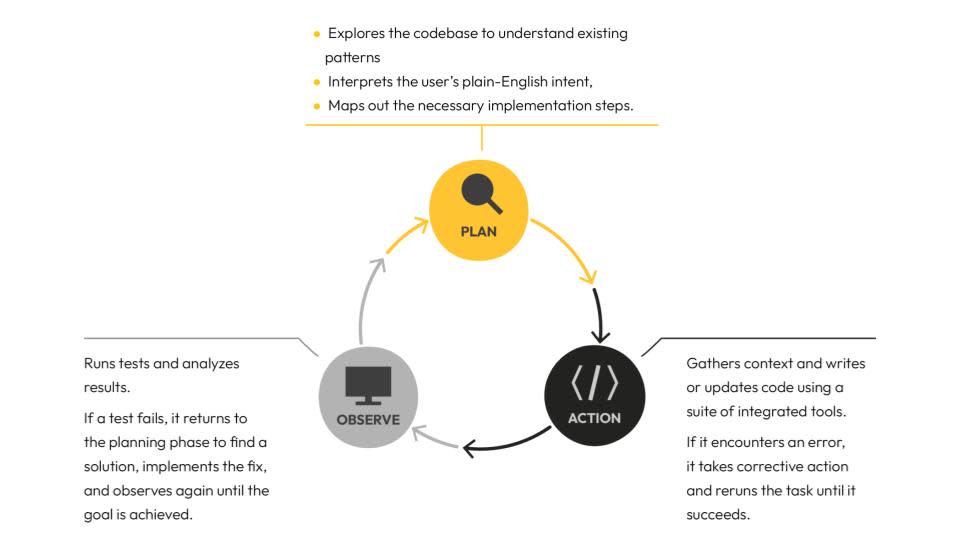
While humans can and do trigger this loop, the Agentic Loop can also be triggered by the environment itself, in response to internal or external events such as code reviews, operational errors, or security alerts. This allows them to operate in a "watch and act" mode around the clock.
For example, AI agents automatically review the inputs, correlate logs across related systems, identify the root cause, and implement a fix. For critical infrastructure, this might mean they follow pre-approved workflows to resolve an issue instantly, or, for more complex cases, they prepare a full diagnostic report and a corrective action for a human to approve.
Traditional AI Copilots | AI Engineering tools (e.g. Codex, Claude Code) |
Assists with code generation | Executes end-to-end engineering tasks |
Produces isolated code snippets | Works within the full system context |
Requires manual integration into systems | Integrates changes directly across files and components |
Testing and validation are manual | Testing and validation are part of the workflow |
Improves developer productivity | Improves overall execution speed and quality |
Human as the Orchestrator
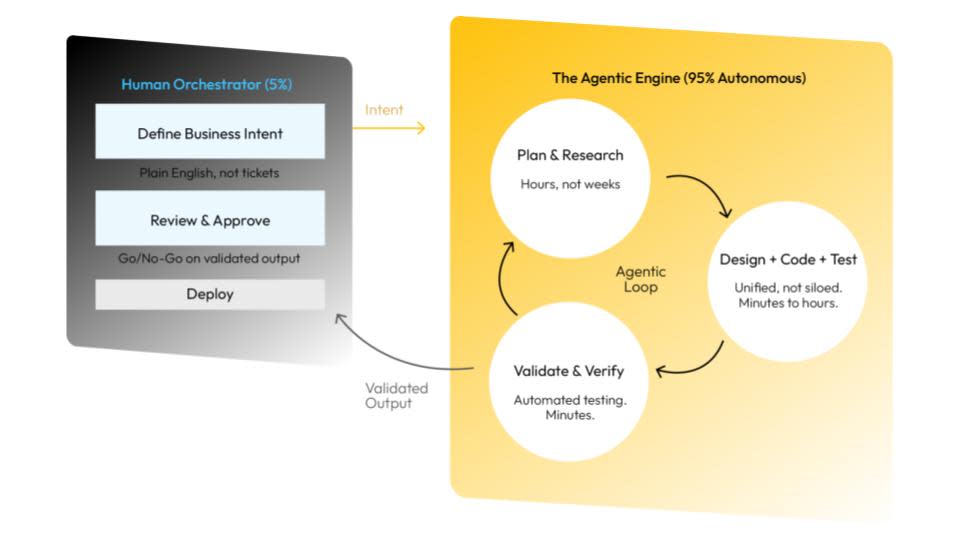
When work flows continuously from intent to outcome, the human role shifts from task execution to strategic oversight. IT engineers, operators, and product owners can focus on high-value decisions that AI is not equipped to handle.
Human orchestrators:
Validate that AI’s proposed workflow plan and approach align with business objectives
Verify that AI implementation meets the actual user's needs.
Make go/no-go decisions based on risk, context, and organisational priorities
Historically, increasing software output required scaling teams. More features, faster delivery, and greater responsiveness all depended on hiring additional engineers.
AI-SDLC changes this dynamic. Organisations can use it to increase their capacity to solve business problems without a proportional increase in headcount. A single product owner can now direct and validate outcomes that previously required a coordinated effort across an entire engineering pod.
Output is no longer constrained by team size, but by how effectively the system translates intent into execution.
For example, when a feature is built, the developer performs a final review to ensure the delivered outcome aligns with the original business requirements. If adjustments are needed, a simple prompt refocuses AI on a new goal, and the cycle begins again.
Human as the Controller
Just as human engineers operate with "least privileged" access, AI agents can be made to function within a strict permission structure and a defined set of policies.
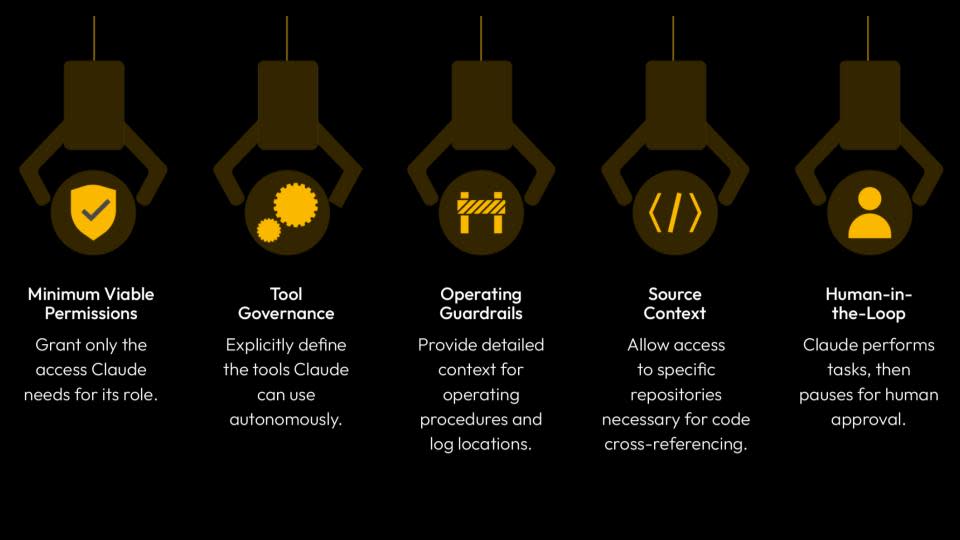
These guardrails codify your organisational security standards and architectural principles into a system that enforces them 24x7.
Advantages of AI-powered Execution
This human-led, AI-agent-powered execution system changes the nature of work itself.
Eliminates Co-ordination Overheads
What previously required coordination across multiple roles and systems can now be significantly compressed into a continuous, largely automated flow, with human oversight applied where it adds the most value. The result is not simply faster task completion, but a redefinition of how engineering work is performed. It shifts how engineering capacity can be structured.
Introduces Visibility
Unlike a human developer working in isolation, the agent provides a real-time, granular audit trail of every action it takes.
The specific iterations it has moved through
Which tests passed and failed
The exact logic used to verify completion.
Leadership can see exactly how close a project is to the finish line.
Eliminates Knowledge Silos
Understanding a complex digital system no longer requires time-consuming discovery phases or reliance on specific individuals. Agents can work across multiple knowledge sources, including code repositories, documentation platforms, and historical records, to build a unified, accurate view of the system. They can:
Provide clear explanations of how code components work, interact, and where changes are needed.
Surface embedded business logic that is rarely documented in legacy systems but critical to correct execution.
Highlight inconsistent or outdated documentation.
Final Words
AI is compressing time-to-market, setting new expectations for delivery speed and customer experience. The impact is being felt in very real ways, from margin pressure and declining customer loyalty to loss of investor trust.
Enterprise leaders face an urgent question: Can IT operations and software delivery keep up with the speed required while operating within resource constraints?
Yes, but pushing automation within an already broken system won't yield the desired results. Execution itself must be overhauled.
An AI agent-driven execution system (AI-SDLC) involves humans orchestrating AI agents that adapt automatically to achieve business objectives and refine themselves daily based on real-world performance data.
Claude Code makes it possible to get such a system up and running. It can be the engine that translates high-level business intent into low-level implementation at unprecedented speed.

