TL; DR: Last year, most Australian companies were experimenting with AI across isolated projects. But 2026 promises to be all about business integration at scale. Those organisations that integrate AI into the core of their operations will lead their sectors over the coming decade.
Few companies are realising meaningful value from AI, despite sustained investment in tools, platforms, and strategy over recent years. While technical capability has advanced rapidly, organisational readiness has lagged behind. AI has often remained confined to proofs of concept rather than becoming a durable part of the enterprise.
The reason for this stems from most organisations treating AI as a “tool” rather than a capability. This has resulted in:
Lack of strategy around AI initiatives, with several being ad hoc, isolated, or slow to start.
Weak AI value definition and measurement, and no clear ownership of AI value
Underdeveloped or unclear pathway from experimentation to AI value at scale
Underlying infrastructure and data challenges
Increased regulatory scrutiny, especially around agentic systems.
Underdeveloped systems for culture and change management that are essential for true AI-driven transformation.
The core issue is a systemic misalignment across strategy, operating model, delivery, and accountability. Organisations struggle because while AI capabilities are boundless, its implications are equally uncharted. There is confusion about how and where to use it, how to run it, and how to maintain it over time.
Fortunately, 2026 promises to bring some clarity! Here are four key shifts that present a clear opportunity for organisations to level up their AI game.
#1 AI Is a Business Transformation, Enabled by Technology
AI’s value is realised not through technology deployment alone, but through changes to how decisions are made, work is executed, and how value is created.
To understand better, let’s look at the previous major enterprise modernisation effort worldwide. The cloud made digital services more cost-effective to run and more repeatable, opening the door for SaaS and whitelabelling. It also improved the organisational business model by enabling scalability at the lowest price point, ultimately lowering the cost to serve a customer.
However, cloud was an IT-led shift focused on infrastructure, scalability, and cost efficiency. Its value was largely realised once the platform was deployed.
AI does not work that way. It comes from the business to IT rather than IT for IT’s sake. AI only creates value when it is trusted to participate in decisions, to shape actions, and to influence outcomes in real time.
This is the critical difference: AI is not a deployment problem; it is a decision and operating model problem. Models sitting behind APIs do nothing on their own. Value appears when AI is deliberately embedded into core workflows alongside humans.
As a result, AI must be led by the business. Leaders must decide which decisions can be accelerated, which risks can be reduced, and where judgment can be augmented. Technology teams then enable this intent by providing platforms, guardrails, integration, and governance. They cannot own the outcomes themselves.
In 2026, leading organisations are reframing AI as a strategic accelerator rather than a technology upgrade. They start top-down with clarity on value, such as revenue, productivity, resilience, or compliance. They then design operating models where AI is part of the control loop, not an isolated innovation experiment.
Technology remains essential, but the sequence is inverted. Unlike cloud, AI succeeds only when leaders define the decisions first, and the platforms, agents, and controls are built to serve those decisions.
#2 AI as the Native Enterprise Intelligence Model
A structured, scalable, and customised approach is necessary to achieve AI success.
The enterprise intelligence model defines how people, processes, technology, and information are used to enable the value of AI at scale. It helps leaders organise key enterprise artefacts so they can achieve their goals within planned timeframes. At V2 AI, we call the shift from ad hoc projects to an enterprise intelligence model “Industrialised AI ”.
Building trusted, production-grade environments with automation, observability, and assurance built in is a key aspect of the model, and a concrete action plan to get started.
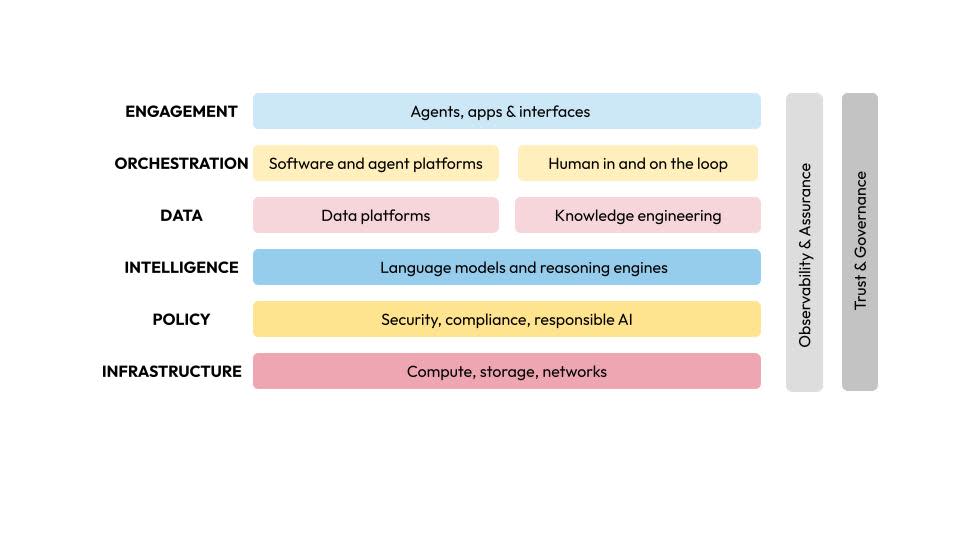
Competitive advantage starts with turning AI ambition into a native, operational reality.
Instead of distributed teams solving the same problems across monitoring, incident management, metric identification, updates, security, orchestration, and so on, organisations should leverage 2026 to build a centralised platform for strategic AI-led innovation.
However, beyond that, organisations have to create a culture of sustainable AI innovation across people, governance, and processes too. Rather than focusing on individual AI solutions, establish a repeatable, organisation-wide way to translate intent into outcomes.
#3 The Rise of Reusable AI Systems
The building blocks of AI systems can be reused to scale faster while meeting security and compliance requirements.
What users experience as “AI” is increasingly a coordinated system of specialised AI agents operating behind the scenes. Each agent is designed to excel at a distinct step within a workflow, collectively delivering outcomes that no single general-purpose model could achieve.
For example, we recently delivered a ticket management solution for a leading bank. Users interact with a single conversational interface to raise requests. Beneath that interface, multiple specialised agents collaborate under an orchestrator. One manages ticket flow, another handles triaging, while a third specialises in resolution.
The power of modular AI like this is that you can build once and reuse bots across multiple workflows and processes. You can accelerate value creation while maintaining control with architectural and strategic foundations.
#4 Increased Focus on Human-AI Alignment
Human-AI integration supports value creation within regulatory requirements.
These early years have shown that most struggling AI initiatives fail socially first. Ownership is unclear, control points are unknown, and the workflow is vague at best. Additionally, over-automation erodes trust faster than cautious progress ever will. These are very familiar change-management problems we all know, now expressed through a new kind of system.
In 2026, most organisations will benefit from building more closely integrated human AI systems.
Human-IN-the-Loop (HITL): The agent proposes actions, but a human must approve them before execution.
Human-ON-the-Loop (HOTL): The agent acts autonomously for low-risk tasks but operates under human oversight; the human can intervene at any time.
Final Words
A massive technology leap from LLM chatbots to AI agents and now agentic within the enterprise occurred in the last 3 years. Naturally, most organisations approached AI through ad hoc department-led projects rather than a centralised, strategic approach. Many are still struggling with change fatigue and a fear of being left behind.
While the pace of enterprise adoption and impact continues to accelerate, the good news is that in 2026, the rate of breakthrough innovation is moderating. Leaders have the opportunity to step back, reset their approach, and make deliberate choices as AI impact increases. You can prioritise and sequence AI initiatives that compound over time to deliver enterprise-wide objectives.
2026 is the year we move from experimentation to tangible end results. Pick one meaningful workflow and build your solution end-to-end. Make sure it is observable, accountable, and secure. Then iterate on it deliberately, expanding its involvement in the business and reusing it to scale across the organisation.
That’s how these systems get better. And that’s how organisations can build an AI advantage that lasts.