
TLDR: Original business requirements are frequently misunderstood or lost as software development work moves through various lifecycle stages. The result is delays and losses in terms of both project and opportunity costs. This article explores how to introduce AI into requirements gathering and design so organisations achieve higher-quality requirements, fewer downstream defects, and substantially less delivery rework.
AI-powered SDLC refers to using AI across the entire software delivery lifecycle, from the moment a business problem is identified to the point where business value is measured in production. To understand it, let’s think of the software development lifecycle as made up of three broad phases.
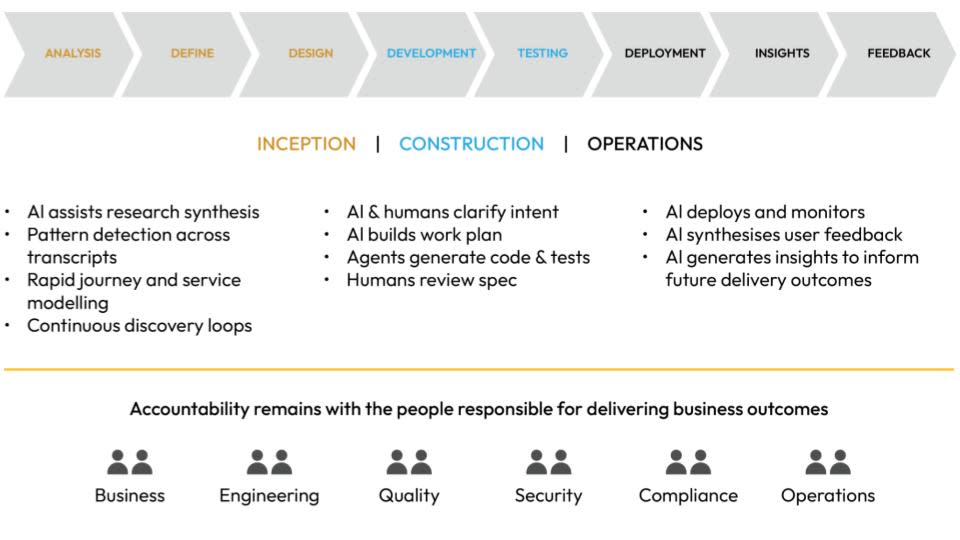
The objective of using AI in the inception phase is not to generate requirements faster, but to improve the quality of decisions that enter the delivery lifecycle. This has a cascading effect throughout the delivery process.
AI-Powered Inception in Action
For example, one of our leading banking clients wanted to improve the mobile business banking experience by providing customers with a personalised fraud investigation view. The existing experience was highly manual, with customers receiving a generic alert that created a poor experience and significant operational overhead due to the high volume of customer clarification calls.
We used AI to generate multiple solution concepts within the bank's existing application design standards and user experience guidelines. This enabled us to quickly trial multiple UX approaches that showed a list of suspicious transactions alongside contextual explanations, such as
Unusual transaction values
Unfamiliar locations
Atypical merchants
Behaviour that differed from historical spending patterns.
Once the product owner selected a design, AI agents were used to generate implementation-ready specifications, acceptance criteria, test scenarios, and compliance considerations.
Outcome
With customer experience, engineering, and risk requirements aligned from the outset, delivery progressed within budget and on time, enabling the customer to achieve a 40% reduction in customer call volume.
Challenges with Traditional SDLC Inception
One of the most expensive challenges is the loss of business intent.
Context Gets Lost in Translation
Business defines the problem and clearly understands the solution. However, as that problem moves through the delivery lifecycle, it is reinterpreted multiple times across teams, with each handoff introducing new guesswork and context loss.
Critical Knowledge Creates Delivery Bottlenecks
Traditional requirements gathering relies heavily on workshops and interviews with a small number of subject matter experts who hold critical business or technical knowledge. Limited availability of these individuals constrains delivery velocity.
Hidden Complexity Slows Delivery
Getting a solution right depends heavily on delivery teams uncovering hidden assumptions, edge cases, and system dependencies. They must piece together information from fragmented documentation and sources. This creates discovery delays and increases the likelihood of gaps.
Late Discovery Drives Exponential Cost
A missed gap discovered during problem definition can often be corrected in minutes. The same defect discovered after the solution reaches end users may require weeks of investigation, redevelopment, testing, and operational remediation. This leads to costly rework with a compounding effect on customer experience and satisfaction.
How AI Creates Clarity
AI creates a shared understanding of success before delivery begins. Every team works from the same foundation rather than creating its own interpretation. As requirements evolve, they continue to enrich the AI context and refine from the same baseline. This dramatically reduces coordination overheads, interpretation gaps, and costly rework later in the lifecycle.
AI can capture business intent in structured natural language and improve information quality. It can also bring the idea to life in more tangible ways, enabling early feedback and refinement before the solution is scaled.
What AI Can Do
AI reviews the proposed business intent to identify ambiguity, challenge assumptions, and surface overlooked information.
AI can highlight operational, regulatory, and reputational risks and recommend additional constraints based on historical delivery patterns.
Create multiple versions of working prototypes for business users to interact with to further refine intent.
Transform requirements into precise implementation and executable acceptance criteria that can be consumed consistently across architecture, engineering, quality assurance, operations, compliance, and security teams.
The Critical Human Role for AI Success in Inception
Humans steer the AI in the appropriate direction and are responsible for providing judgment, context and approval.
Articulate Business Intent
Clear articulation of business intent is necessary through standardised templates that specify:
The desired outcome in measurable business success metrics
The reasoning behind why it matters now
All operational, regulatory, commercial and other constraints
Maintain Knowledge Context
Humans must maintain information on existing systems, including their internal and external dependencies, data stores, ownership, SLAs, known failure modes and incident history. They must also update and maintain all organisational design context, such as brand assets, accessibility standards, and tried-and-tested user experience patterns. The more information and context are documented in a format that AI understands, the better the AI outcome.
Review AI Recommendations
Humans must review all AI recommendations and provide feedback on any context it may have missed or hallucinated. They remain accountable for all final decisions.
Traditional SDLC | AI-Powered SDLC |
Write requirements documents. | Guide AI to generate and refine requirements. |
Conduct workshops to manually capture requirements. | Use AI-assisted discovery to rapidly explore business needs, risks, and opportunities. |
Create user stories and acceptance criteria. | Validate and refine AI-generated specifications. |
Build wireframes and Figma prototypes. | Direct AI to generate and iterate on prototypes. |
Manually analyse dependencies and impacts. | Review AI-generated impact analysis and dependency mapping. |
Research policies, standards, and historical decisions. | Provide context that helps AI incorporate organisational knowledge automatically. |
Translate business language into technical language. | Ensure AI maintains alignment between business intent and technical execution. |
Produce delivery artefacts. | Govern delivery decisions. |
Final Words
Inception is just the start. AI can be used throughout, from development and testing to operations, to accelerate software delivery.
The result is a shift from software delivery to business value delivery.
The software development lifecycle becomes a continuous system, with business intent flowing directly into engineering execution. There is no more lag due to missed context, coordination overhead, or rework. Operational insights inform future priorities, creating a continuous loop from business strategy to value and back.
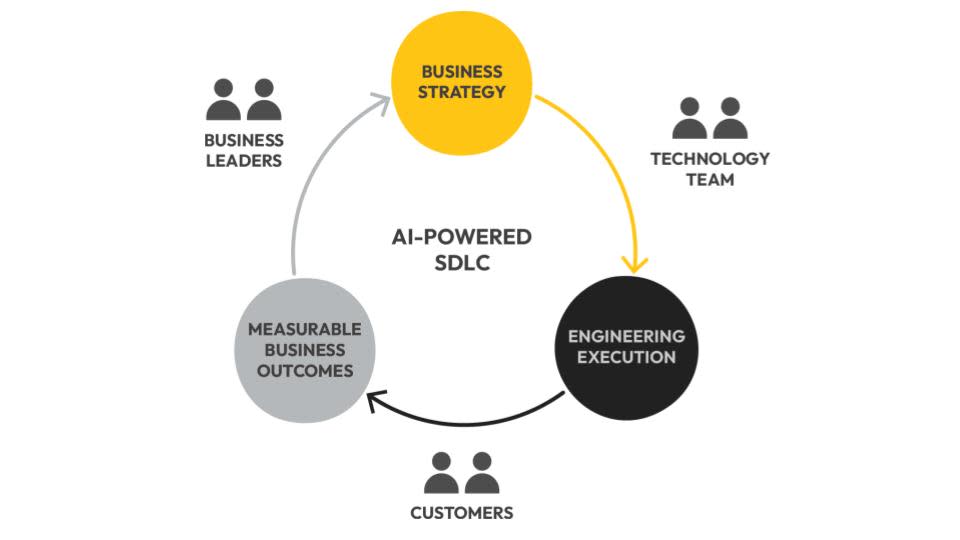
The future belongs to organisations that embed AI throughout the delivery lifecycle, supported by governance, measurable outcomes and clear accountability.