

TL;DR: As attack timelines compress and environments grow more complex, legacy vulnerability management can no longer keep up. This article explores why traditional vulnerability management fails and how AI can mitigate vulnerability risks.
Cyberattacks have evolved and scaled at an unprecedented pace. CrowdStrike’s Global Threat Report 2026 states that Nation-state attacks jumped 266% overall, with attackers now moving laterally across the network in just 29 minutes. The fastest breakout time was a mere 27 seconds!
This creates an uncomfortable asymmetry for overwhelmed enterprise security teams. Analysts spend countless hours triaging issues that never materialise into real risk, while genuine weaknesses get buried in noise. Alert fatigue is endemic as vulnerability volumes continue to grow.
Traditional vulnerability management was designed for a slower threat environment, emphasising completeness over relevance, and reporting over action. It was built around a stable set of assumptions that have now changed.
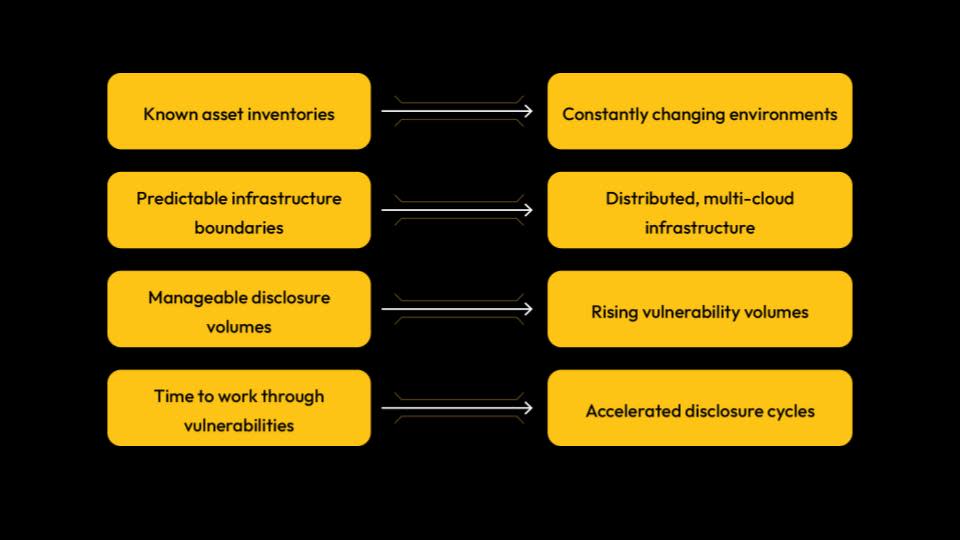
Risk-based Vulnerability Management
A new approach is necessary that prioritises vulnerabilities based on likelihood of exploitation and business impact. It is the explicit encoding of organisational risk appetite into automated risk mitigation.
From a technical perspective, risk is determined by aggregating multiple signals.
Asset criticality and business ownership
Threat intelligence and dark web chatter
Internal telemetry and behavioural indicators
It requires ingesting massive data streams, correlating them, appropriately weighting them, and continuously updating a risk-adjusted score for every vulnerability as conditions change.
Organisations score and contextualise risk, then translate risk posture into automation aligned to their appetite. For example:
Monthly baseline patching for standard systems
Accelerated remediation for browsers and externally exposed services
48-hour response for actively exploited critical flaws
Immediate emergency workflows for zero-days
When those rules are configured correctly, remediation workflows are triggered automatically based on defined thresholds. Escalation is reserved for scenarios that require executive judgment, shifting vulnerability management from activity tracking to risk control.
How AI Transforms Vulnerability Management
AI augments vulnerability management end-to-end, compressing analysis time and directing human expertise toward vulnerabilities with real business consequences.
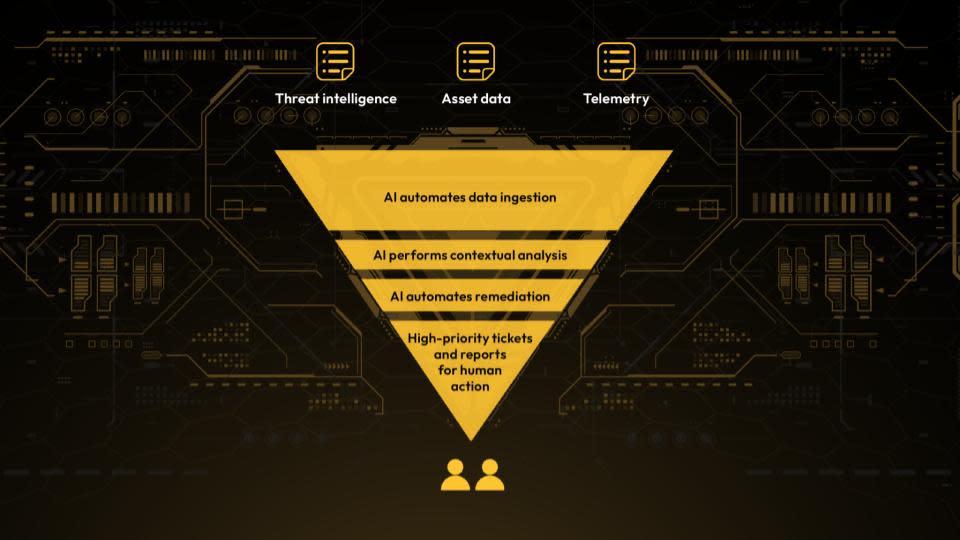
AI Automates Data Ingestion
AI automates data collection processes so vulnerability intelligence is continuously updated, clean, and decision-ready. Real-time information flows replace static, point-in-time snapshots.
Risk-based vulnerability management requires data from multiple sources to provide a complete vulnerability context. However, these sources vary in structure and volatility.
Scanner outputs vary by vendor.
Cloud workloads generate nested JSON structures that evolve weekly.
Threat intelligence arrives as free text, PDFs, or API feeds.
Exposure context shifts as assets spin up and down.
As a result, security teams may end up spending disproportionate effort on writing and maintaining connectors that pull data across systems. Schema changes and API updates may still cause failures.
AI agents can manage ingestion workflows end-to-end, escalating only when anomalies require human oversight. E.g. you can use them to:
Learn patterns for structuring and relating vulnerability data.
Parse unstructured content, such as advisory notes, patch descriptions, threat reports, and change logs.
Identify missing or redundant data, normalise attributes, and adapt when data source systems change.
Automate documentation to explain transformation logic for governance and audit purposes.
The Human-AI Interconnect - AI does not replace data engineering; it industrialises it. Human-in-the-loop validation remains essential to prevent misclassification or silent data corruption. Choices about centralisation, cloud strategy, and ecosystem integration remain leadership decisions.
AI Automates Contextual Analysis
AI considers reachability, environment, business impact, and compliance to prioritise vulnerabilities based on real-world risk, while reducing the overwhelm.
Analysis | How it works | Example |
Reachability Analysis | AI analyses your application’s execution flows, code paths, and runtime behaviour. If a vulnerable function is unreachable, protected by conditional logic, or shielded by runtime controls, the risk profile changes materially. | A CVSS 9.8 on an isolated internal service has lower priority than a CVSS 8.2 on an internet-facing workload handling sensitive data. |
Environment Analysis | AI correlates identity reachability, network paths, excessive permissions and service exposure to identify the misconfigurations and vulnerabilities that together create viable attack paths. | A medium-severity vulnerability (CVSS 6.5) in a container image running in a cloud workload with an overly permissive IAM role is more critical than one with limited access. |
Business Impact Analysis | AI incorporates asset criticality, service dependency mapping, and revenue impact modelling to determine business consequences. | A medium-severity flaw affecting a customer-facing revenue system represents greater enterprise risk than a high-severity issue on an internal application. |
Compliance Analysis | AI maps findings against control frameworks such as the Essential Eight or the NIST, surfacing vulnerabilities that breach mandated control requirements. | A remote code execution vulnerability with a CVSS score of 9.0 is automatically escalated for remediation within 48 hours because it breaches patching thresholds under the Essential Eight framework, even though it affects a third-party application rather than internally developed code. |
The Human-AI Interconnect - AI improves prioritisation accuracy and dramatically reduces noise, but accountability, risk appetite, and final decision authority remain human responsibilities. AI can estimate risk, but leadership must define acceptable exposure.
AI Automates Remediation
Beyond ranking vulnerabilities, AI can also dynamically allocate resources and directly generate remediation artefacts.
AI agents can:
Analyse vulnerable source code and generate human-readable explanations of the flaw.
Propose safer function replacements (e.g., replacing unsafe input handling patterns).
Draft patch diffs aligned to coding standards.
Generate remediation guidance for infrastructure misconfigurations.
Produce structured change tickets with contextual evidence attached.
Agentic systems also take into account that vulnerability remediation is not a one-time decision, but a continuous, sequential allocation problem under uncertainty. The AI agent evaluates vulnerability priorities within the context of available engineering bandwidth and SLA constraints. It determines which vulnerabilities should be addressed first and who should address them.
The Human-AI Interconnect - AI optimises remediation decisions and accelerates repair. It does not replace governance, accountability, or engineering discipline.
Final Words
In a traditional vulnerability program, analysts act as queue workers that triage findings, enrich tickets, and manually assemble CAB artefacts. In an AI-enabled model, operational tasks are automated. The human function shifts toward supervision, policy definition, and validation.
AI provides scale, speed, and consistency.
Humans provide judgment, accountability, and governance.
It is the only sustainable way to reduce fatigue without surrendering control.