

TLDR; As enterprises increasingly adopt frontier models from providers such as Anthropic, tracking how and where data is used becomes a critical regulatory concern. This article explores key responsible AI principles when integrating frontier models into enterprise workflows.
A large bank wanted to scale AI adoption across the organisation. Rather than approving each use case on its own, it set out to build a shared AI foundation, with security, risk management and compliance built in from day one, that every team could reuse. The aim was to improve operational efficiency, reduce manual effort and free teams for higher-value work.
The value lay in using Claude on the bank’s business-critical operational data. That brought the Australian Prudential Regulation Authority’s (APRA) requirements into play, covering service provider risk, information security and operational resilience. Under the shared responsibility model, Anthropic and AWS security certifications cover their own services. The bank still had to show how its own deployment handled its data.
This highlights a broader challenge for enterprise AI. Credentials cannot answer the risk committee’s most important questions about how business data is processed and held in a specific deployment. Organisations need evidence of how data is handled throughout the deployment lifecycle.
Trust Starts with Knowing Where Your Data Goes
For frontier AI, trust starts with two fundamental questions.
Where does the AI model process data?
Who holds the data, including the logs the system creates?
The two questions often have different answers. Data can be stored in an approved jurisdiction while the model processes it somewhere else. AI systems also create new information, such as conversation logs, monitoring data, and audit records, that someone has to hold. The organisation remains responsible for classifying and protecting that information, regardless of which party operates the system.
Requirements for both differ by industry, and within an industry they depend on the data each workload uses. The table below summarises the main obligations across four Australian sectors.
Industry | Processing | Holding |
Financial services | CPS 230 requires APRA-regulated entities to manage risks from material service providers, and to notify APRA before entering a material offshoring arrangement. | CPS 234 requires entities to classify information assets by criticality and sensitivity, including assets managed by third parties, and to protect them accordingly. |
Mining, utilities and energy | Security of Critical Infrastructure Act requires responsible entities to manage material risks to critical assets, including supply chain risks from the providers that store or process their business-critical data. | Where an AI system handles business-critical data for a critical asset, the system, its logs and its dependencies belong in the asset’s risk management program. |
Retail | The Privacy Act's APP 8 applies when personal information is disclosed to an overseas recipient. Organisations must take reasonable steps to ensure the overseas recipient does not breach the APPs and can remain accountable for the recipient's handling of the information. | APP 11 requires organisations to protect personal information from misuse, interference, loss and unauthorised access, and to destroy or de-identify it once it is no longer needed. |
Australian public sector | The Protective Security Policy Framework (PSPF) and Information Security Manual require agencies to manage classified information throughout its lifecycle. For sensitive and classified workloads, the government's hosting and cloud frameworks place particular emphasis on security, sovereignty and risk assessment. | The Hosting Certification Framework applies to Australian Government hosting arrangements for sensitive government data and systems rated PROTECTED, with requirements covering privacy, sovereignty and security. |
Balancing Provider Oversight with Enterprise Data Control
Frontier model providers need mechanisms to detect and respond to sophisticated misuse within their environment. Some forms of misuse develop across multiple sessions, accounts and interactions. An individual request may appear legitimate in isolation, while the pattern of activity over time indicates an attempt to misuse the system.
Detecting these patterns requires activity to be retained and analysed. That retention is a security control, not a training pipeline, but it still creates a challenge for enterprises: the provider may end up holding data the organisation would rather keep in its own environment.
For enterprises, the question therefore becomes how to balance two objectives: maintaining control over sensitive data while ensuring sufficient monitoring to operate frontier AI safely.
Anthropic’s New Approach to Enterprise AI Safety
In September 2026, Anthropic announced Enterprise Frontier Safeguards, which combines zero data retention with automated monitoring for serious misuse. It entered public beta in November 2026.
Standard zero data retention relies on real-time classifiers that screen each request on its own. Enterprise Frontier Safeguards keeps those classifiers and adds monitoring for misuse patterns across many requests. This matters because sophisticated attacks often split harmful work into requests that each look harmless. The activity data used for monitoring sits in cloud storage your organisation controls, such as Amazon S3 or Google Cloud Storage, rather than with Anthropic. It is available on the Claude Platform, Claude Platform on AWS, Amazon Bedrock and Claude on Google Cloud.
Responsibilities are split:
Your organisation holds the data. It stays in your cloud account, encrypted with your keys and governed by your access policies and audit logging. No Anthropic or cloud provider staff can read prompts or responses, and the data is never used for training.
Detection runs automatically. Through Amazon Bedrock or Claude on Google Cloud (Google Managed), your cloud provider operates it, and the data stays within that cloud’s boundary. Otherwise, Anthropic operates it.
Your team owns the response. Flags arrive as Safety Cases, which your team reads from storage or through an API and can route into its security monitoring platform. Only your team sees the prompts and responses behind a case. Anthropic sees case details such as the harm category and status.
Example Scenarios
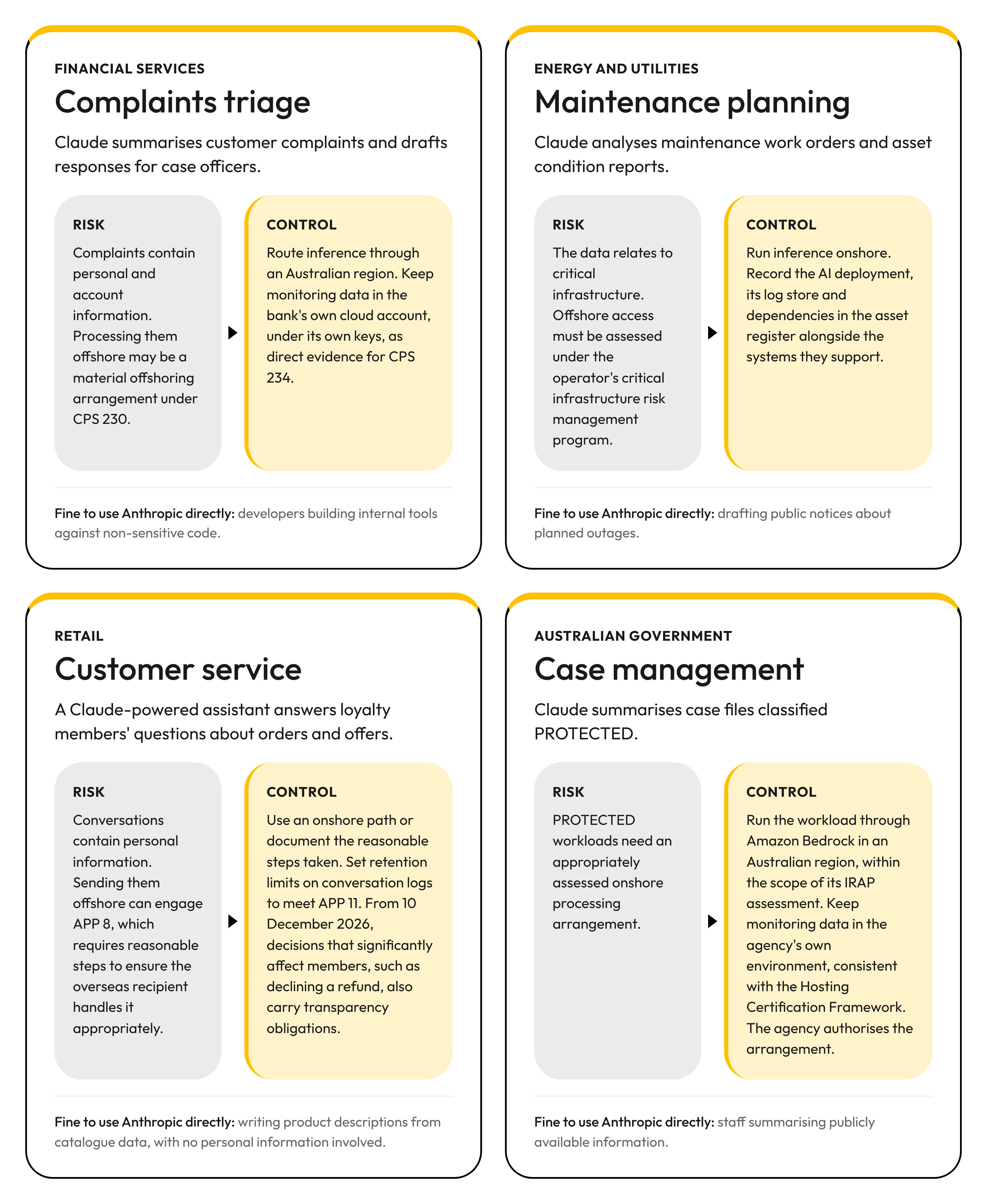
In practice, data classification determines how you access Claude. Sensitive workloads run onshore through a cloud platform, while lower-risk work can use Anthropic’s service directly. The scenarios below show how this plays out in each industry from the table above.
Four Principles for Building Trust in Frontier AI
Organisations need to demonstrate that the right controls are in place and that the evidence supporting the decision remains current. The following four principles help organisations build the second kind, the kind they can show a risk committee, regulator or auditor.
Separate Processing from Holding
When organisations treat data holding and data processing as a single question, they reject viable AI use cases based on incomplete information.
Assess the two separately to identify the specific controls required and design an appropriate deployment.
Prioritise Evidence over Commitments
Certifications, contracts and security assurances matter, but they don’t show how a specific deployment is configured. Data held in your own environment, under your own keys and access policies, is a control you can demonstrate directly.
Record processing and holding decisions to create auditable data that can feed into the organisation's broader risk management framework.
Give Detection Clear Ownership
Monitoring only helps if someone acts on what it finds. With Enterprise Frontier Safeguards, flags go to your own security team, so the response is yours to own.
Before go-live, agree who receives alerts, how they are classified and when they are escalated. Set response times by your own regulatory deadlines, such as notifying APRA within 72 hours of a material information security incident under CPS 234, not by the vendor’s.
Establish who receives alerts, how they are classified and when they are escalated.
Keep Evidence Current
Models, regional availability, certifications and deployment settings change with every release. Evidence gathered last quarter may already be out of date.
Review it on a set schedule, and whenever a model, region or configuration changes. Trust needs ongoing review. It can’t be established once and assumed to last
Maintain trust through ongoing review, not established once and assumed to persist.
From Commitments to Evidence
What a risk committee needs is evidence for every workload demonstrating where it is processed, who holds its data, and proof that the controls are configured as approved and still working.
Anthropic’s certifications and commitments remain the foundation. Enterprise Frontier Safeguards adds something certifications can’t; evidence the customer can directly control and manage.
This has given organisations an opportunity to relook the list of AI use cases set aside because the data couldn’t leave the organisation’s control. That list is usually longer than expected, and it often holds some of the most valuable work in the portfolio.
V2 AI helps Australian enterprises design and evidence such highly regulated deployments, from data classification through to onshore architecture and monitoring. Contact us to learn more.