
TL;DR: Many enterprise organisations are attempting to roll out Claude Code across engineering teams to accelerate delivery speed and associated business outcomes. Allowing individual developers to design and run Claude Code agents in isolation brings creativity and speed, but can also create higher levels of inconsistency and risk. This blog outlines how to design a governed system for human engineers and AI agents to work together.
Claude Code lets organisations run both single-agent and multi-agent engineering teams to complete increasingly complex software tasks at unprecedented speed. The productivity gains can be transformative; however, what begins as experimentation can rapidly evolve into operational sprawl.
Moving beyond pilots into production-scale transformation requires implementation expertise alongside the technology. V2 AI Claude Code workshops are a vital step in that journey. They run across Australia and can also be delivered privately in-company, tailored to your enterprise to give your senior leaders and their teams the hands-on experience they need to move forward.
Behind the Workshops: Anthropic's Select Partner
V2 AI has formed a strategic partnership with Anthropic, giving APAC enterprise clients direct access to cutting-edge AI capabilities alongside deep implementation expertise.
We were among the first partners to earn Anthropic's Claude Certified Architect - Foundations certification, with 20+ Claude Certified Architects across the team and early access to new Claude capabilities through Anthropic’s Early Access Program.
Claude Code workshops are also part of that partnership, launching across Sydney and Melbourne in June 2026.
What Happens in the Room: Hands-on, Not Hypothetical
The Claude Code workshops are practical and interactive sessions in which participants work through real-world scenarios, covering:
AI-driven software engineering
Systems modernisation
Engineering automation
Delivery workflow optimisation.
Sessions are built for both senior stakeholders and technical teams, giving enterprise leaders the strategic context to make informed decisions, while engineering teams see exactly how integration works in practice.
The format also creates a structured space for peer exchange: senior leaders from across industries compare approaches, share what's working, and pressure-test their AI roadmaps against others navigating the same challenges.
Private Workshops, Tailored to the Enterprise
V2 AI also delivers in-company Claude Code workshops shaped to the enterprise for organisations that want to run the workshop with their own engineers, on their own codebase, and behind their own security model.
We adapt the agenda to each organisation's priority engineering workflows, the regulatory and governance constraints it operates under, and the use cases its teams are already exploring. The session is delivered on-site by the same engineering and architecture leads who run the public series and keep the same hands-on, real-codebase format.
Why Claude Code Usage Must be Planned and Controlled
The challenge is that there are effectively unlimited ways to use Claude Code. Different teams naturally develop their own execution patterns. Some approaches may improve quality, while others may escalate infrastructure costs, security vulnerabilities, and production bugs.
How can organisations ensure every engineering team is using Claude Code in the safest, most effective, and most trustworthy way possible?
By shifting engineering focus from writing better prompts to designing structured workflows that govern how context is managed and execution is controlled. The result is consistent, high-quality outcomes that scale across teams.
Traditional | Agentic (no system) | Agentic (with system) | |
Process | Developer codes feature over days, design decisions can be explicit or implicit | "Add OAuth" → 20 min of code → 2 hours of corrections | Spec → plan → decompose to tasks → execute per task → testing → review |
Quality | Depends on the developer | Inconsistent | Architecturally consistent |
Artifacts | Code only | Code only | Spec + plan + code |
Review | Normal | Painful inconsistent patterns | Clean follows existing conventions |
Structure Execution Through a Defined Pipeline
Initially, humans retain total control, but progressively grant the AI agent more autonomy while narrowing the solution space.
Design systems in which agents operate within clear constraints, producing outputs that are predictable, consistent, and easier to validate. By investing effort upfront, teams create the conditions for fast, accurate, and scalable execution.
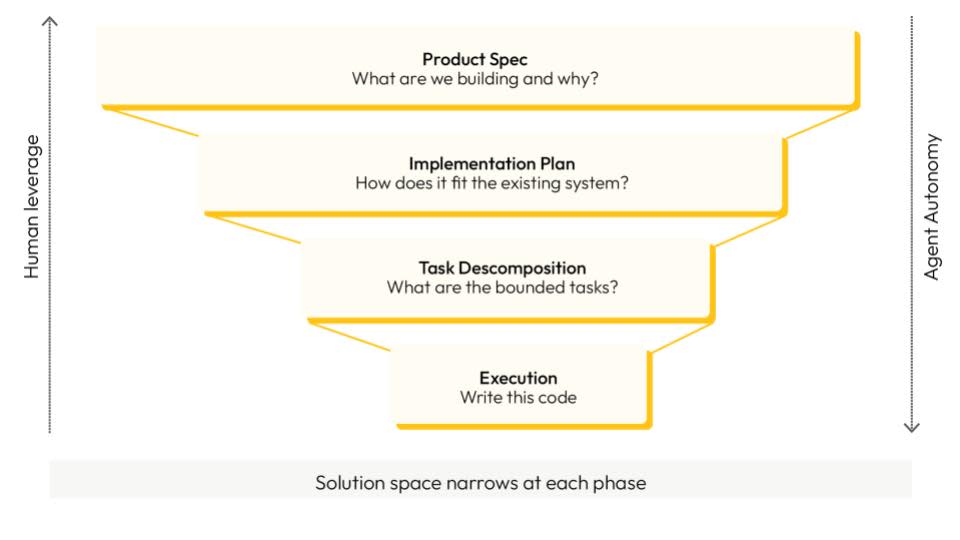
The above pipeline enforces the separation of code reasoning from code writing. Prompts and agent operations vary as the agent’s role shifts from design to implementation.
Architect Session | Implementer Session | |
Goal | Decide what to build and how | Build exactly what the plan says |
Mode | Research, analyse, propose | Execute, test, commit |
Prompt style | "Read the codebase and propose a design. Do not write code." | "Implement task 3 from the spec. Follow the pattern in userService.ts." |
Produces | Design spec, task breakdown, file references | Code, tests, documentation |
Context | Broad, explores multiple files to understand patterns | Narrow, scoped to one task and its referenced files |
Review point | Humans review the plan before any code exists | Human reviews code against the plan |
Addressing Human Review Bottlenecks
The engineering team’s ability to ship is no longer limited by how fast they code. It's limited by their skill in reviewing and their discipline in specifying.
AI shifts human engineering work from doing to reviewing. However, reviewing AI-generated output can sometimes take longer because it's syntactically fluent but sometimes semantically confused. Bugs hide better.
Three countermeasures that work:
Automated verification as first defence. Tests, linters, type checkers catch mechanical issues. Humans focus on architecture and business logic.
Writer/reviewer pattern. One AI session generates output, which is then reviewed by a separate, fresh session. Different context, different anchoring, catches different errors.
The two-correction rule. If the output doesn’t align in two attempts, clear the session, tighten the spec, and start fresh. Encourage your developers to avoid the iterative correction spiral.
Understanding Claude Code Costs
Understanding the cost profile of Claude Code requires a shift from traditional cloud cost thinking. Cost is not driven by infrastructure alone, but by how effectively the system is designed, routed, and operated.
Model Selection
Claude offers three-tier pricing with Haiku models being the least expensive, followed by Sonnet, then Opus. Using the wrong model for the wrong job quickly inflates spend. Most teams overuse high-end models, driving unnecessary cost without proportional value.
Caching
When you use Claude Code agents, the system constantly sends context to the underlying large language model. Instead of reprocessing the same information at full cost every time, the model caches that context. When reused, it is read back at a much lower cost.
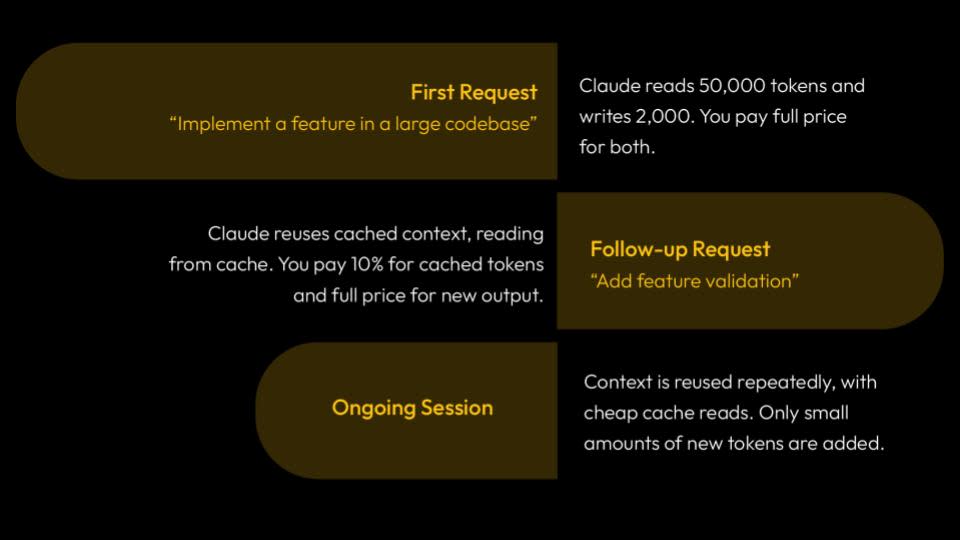
That way, you pay most for “new thinking,” and less for the reuse of previously processed context. Hence, the total number of tokens does not give the complete picture.
Teams that do not segment token usage by type often misinterpret where spend is actually occurring.
The real risk is not volume but how often you force the system to reprocess rather than reuse. Uncontrolled loops, retries, and repeated context loading multiply costs 3–7× without optimisation.
Final Words - From Workshop to Boardroom
The AI-driven development lifecycle reduces cognitive load, allowing engineers to shift from repetitive tasks to higher-value problem-solving and unlock outcome-driven innovation. However, AI also magnifies both organisational strengths and weaknesses.
V2 AI Claude Code Workshops help organisations prioritise laying the systemic agentic engineering foundations necessary for long-term gains.
The benefits extend well beyond the room. Participants leave with a practical understanding of how Claude Code works within enterprise environments, hands-on experience with AI-assisted workflows, and clear strategies for scaling AI responsibly.
From governance and security to identifying high-value opportunities, attendees gain a realistic understanding of how AI can deliver measurable business outcomes today, not just in the future.
Reserve a place at the next Sydney or Melbourne workshop - or talk to our enterprise AI team to find out more.
FAQs
How do you govern Claude AI?
Claude governance should define acceptable use, risk and safety guardrails, privacy-preserving interaction patterns, clear ownership, monitoring, evaluation and escalation processes. The controls should align with an organisation’s policies, risk profile and regulatory obligations.
Is Claude Code suitable for enterprise use?
Claude Code can support enterprise teams when introduced with secure development practices, governance controls, developer enablement, appropriate access management, testing, review processes, and clear operational guardrails.
What are Claude AI agents?
Claude AI agents are systems that use Claude to reason through tasks, coordinate tools and systems, manage workflow steps, and escalate exceptions to people where human oversight is required.