
TL;DR: Claude Code represents a new class of AI technology transforming software development exponentially faster than any automation or AI copilot has before. This blog explores the why and how of this shift and presents practical strategies for organisations to stay ahead of the curve.
We saw the power of Claude Code in action during a recent engagement.
The V2 team used Claude Code to deliver a production-ready, greenfield upgrade to a self-service platform in retail. Delivered with 50% fewer engineers, the approach significantly reduced development cost as Claude Code transformed every aspect of project delivery from architecture to implementation and testing. It has helped the client realise:
Reduced time-to-market - As delivery velocity increased by more than 80% since the previous development cycle
Proactive risk identification and resolution - Claude Code surfaced critical 3rd-party API deprecations within 24 hours, enabling the team to rapidly adapt and avoid downstream delays.
Accelerated confidence in production readiness - Claude Code created a full test harness and real-user environment simulation in under an hour.
The benefits of AI-agent-driven development are clearly visible, but this is just the start. Claude Code is creating a fundamental shift in how engineering work is designed, delivered, and governed.
Understanding the Shift
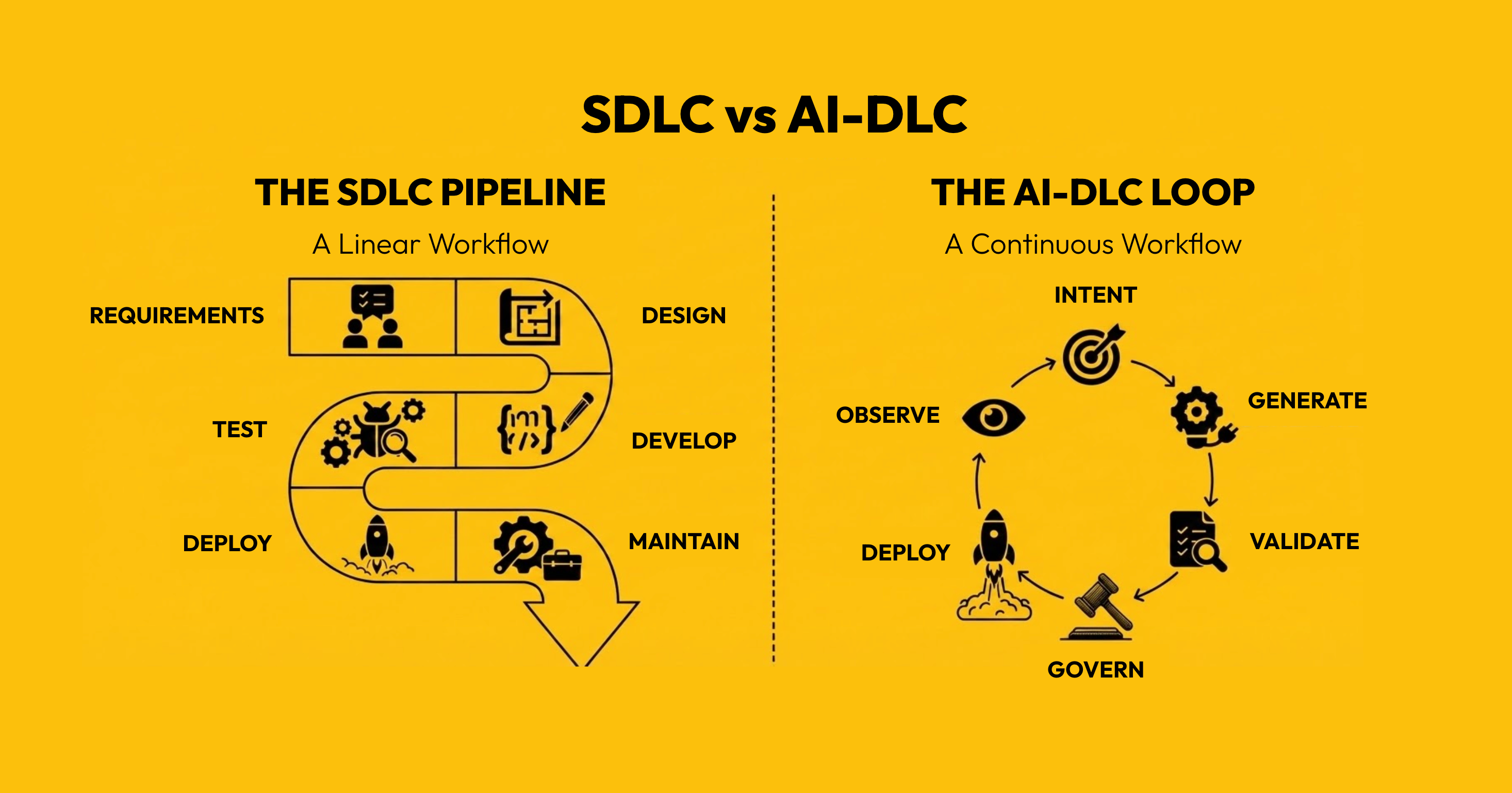
The software development lifecycle (SDLC) evolved slowly over the last five decades, moving from waterfall to agile ways of working in the early 2000’s. Although DevOps, QA, and other related automation have become mainstream, work continues to follow a linear path from one phase to the next. Work is planned, executed, tested, and deployed, with hand-offs and pauses at every step.
The AI-agent-driven development lifecycle (AI-DLC) creates an opportunity for work to flow continuously with little disruption. AI agent tools like Claude Code can integrate into your core engineering environment, understand your unique context, and plan, execute, and validate in a single workflow, with human approval at checkpoints.
Context Is the New Productivity Unit
In traditional SDLC models, productivity is measured by how quickly developers can write and debug code. In an AI-DLC model, outcomes are driven by how well teams define the context (the environment) in which AI operates.
Product requirements, API specifications, architecture diagrams, and design artefacts are initial inputs. Within a well-defined context, AI generates features, validation logic, and test scenarios simultaneously, exploring permutations at a scale that human teams cannot match. Over time, it starts building its own context and makes higher-level suggestions that require steering based on sound engineering principles.
Code generation is no longer a ceiling. Engineering productivity shifts from manual build to intelligent orchestration.
Quality Becomes a System, Not a Task.
In traditional SDLC models, QA is introduced late, after development is complete. In an AI-DLC model, validation is designed upfront and generated in parallel with development.
AI translates requirements directly into validation logic. This creates faster feedback loops, reduces technical debt earlier, and improves collaboration across teams.
Quality now spans the entire lifecycle, with broader, deeper test coverage.
A New Delivery Standard Emerges
Historically, delivery was slowed by dependencies on developer knowledge transfer and system availability. AI removes these bottlenecks.
Traditional SDLC forces work to progress through largely sequential workflows. In AI-DLC, AI keeps work moving continuously. It translates requirements, APIs, and UI definitions into structured test logic in parallel with development. It can also deploy, monitor running systems, and plan the next iteration based on feedback.
Instead of waiting for artefacts to stabilise, the software evolves continuously alongside implementation. You get faster delivery with continuous assurance and increased confidence in deployment.
What this Means for Enterprise Engineering Leaders
The role of engineering shifts from managing effort to ensuring the integrity, resilience, and continuous improvement of intelligent systems.
Leaders need to recognise the evolving role of human engineers in AI-DLC. It is no longer just about building software, but about orchestrating the design, validation, and safe governance of AI's workflow at scale.
Treat Context (Knowledge) as a Core Engineering Asset
Senior engineers and leaders are responsible for ensuring that any AI-driven development is not only efficient but also correct, explainable, and aligned to business outcomes.
In the AI-DLC model
Context quality determines AI reliability
Data lineage determines AI trust
Both are sustained when knowledge curation is treated as a core engineering discipline, with clear ownership, standards, and governance.
In Practice
Organisations must build and manage context supply chains. This includes prompt and context versioning, data lineage and traceability, and lifecycle management of knowledge assets.
When done well, these supply chains become highly trusted corporate assets that accelerate innovation while maintaining control and accountability.
Manage Hallucination Risk with Structured Validation
While hallucination has reduced significantly in current AI models, false confidence is a risk inherent to the technology.
AI systems can generate outputs that appear correct but are logically flawed, introducing invisible technical debt and cascading risks across systems. AI outputs may also change in style or logical direction as underlying models advance and upgrade.
Leaders must treat this as a core engineering concern.
In Practice
Embed structured control mechanisms into the development lifecycle to continuously validate AI outputs. This could include implementing:
Validation gates, such as reasoned validation, to ensure outputs are explainable
Fault injection testing to verify system behaviour under failure conditions
Human-in-the-loop oversight for critical decisions.
Human oversight does not slow AI down. It ensures that speed is aligned with risk authorisation, outcome validation, and overall system integrity.
Align on Outcome-Driven, Continuous Metrics
In an AI-DLC model, measurement shifts from milestone-based tracking to continuous evaluation. Traditional delivery metrics are no longer sufficient.
In Practice
Establish a continuous measurement framework across context, generation, validation, runtime and learning. It should connect requirements to runtime performance.
Track drift and regression over time.
Expand test coverage beyond code to include context, data, and model behaviour.
Leaders must align on metrics that reflect system performance, reliability, and real business outcomes.
Final words
As AI assumes responsibility for syntax and generation, human value shifts toward judgment, context, and intent.
Successfully adopting AI-DLC requires a shift in mindset. Engineering teams must:
Unlearn reliance on manual execution as the primary value driver.
Learn how to design prompts, structure data, and govern AI safely.
Re-learn the business logic and domain knowledge that determines correctness.
Reaffirm that quality remains the signature within a more systemic approach.
AI does not replace core engineering principles; it amplifies them. Used without discipline, AI creates technical debt faster than any previous technology. Used with strong governance and thoughtful design, it enables unprecedented acceleration through leading technology and utmost confidence.