
TLDR: Faster code generation alone doesn’t guarantee quicker delivery. Developer co-pilots cannot resolve bottlenecks in testing, deployment, and collaboration. This blog explores ways AI can be integrated to truly accelerate delivery in your organisation.
In our conversations and work with clients, we gain firsthand insight into how various teams are using AI to improve delivery efficiency. Many efforts are employee-led, where AI is used to generate meeting transcripts, collate disparate documents, and auto-convert them into project knowledge bases.
AI features within project delivery tools are also useful. For example, generating Jira stories from requirements documentation or scaffolding story templates from past stories are some great examples of how AI makes the delivery manager’s work a bit easier.
However, organisations should not limit themselves to these early successes. With AI capabilities cutting down development cycles from weeks to days, it must also be integrated deep into delivery practices and the pipeline to realise the full benefits.
What is needed is a shift from delivery teams that use AI to teams that are AI-enabled.
Business outcomes of doing so would include:
Reduced operational costs as team productivity boosts.
Higher product quality as AI reduces friction between business and engineering.
Faster decision-making by removing bottlenecks across requirements, development, testing, and deployment.
Greater consistency and predictability in delivery as pipelines become more resilient, and issues can be proactively resolved.
Here are some practical approaches to achieving this.
AI for Information Retrieval
As a first step, it is essential to start every project by having AI collate all communication, documents, and meeting recordings. This could be through a Google NotebookLM or a Claude project. These tools allow us to upload relevant documents, including meeting transcripts, and share them with the team.
This central knowledge repository could quickly provide the information stakeholders need without requiring documentation of every obscure fact.
For example, when working with a large finance client, we set this up from the get-go. Later on, when engineers were searching for some challenging networking requirements, the AI quickly provided the answer from old meeting transcripts. Without this, we would have ended up with long email threads and communication bottlenecks as we tried to re-obtain the information from the client.
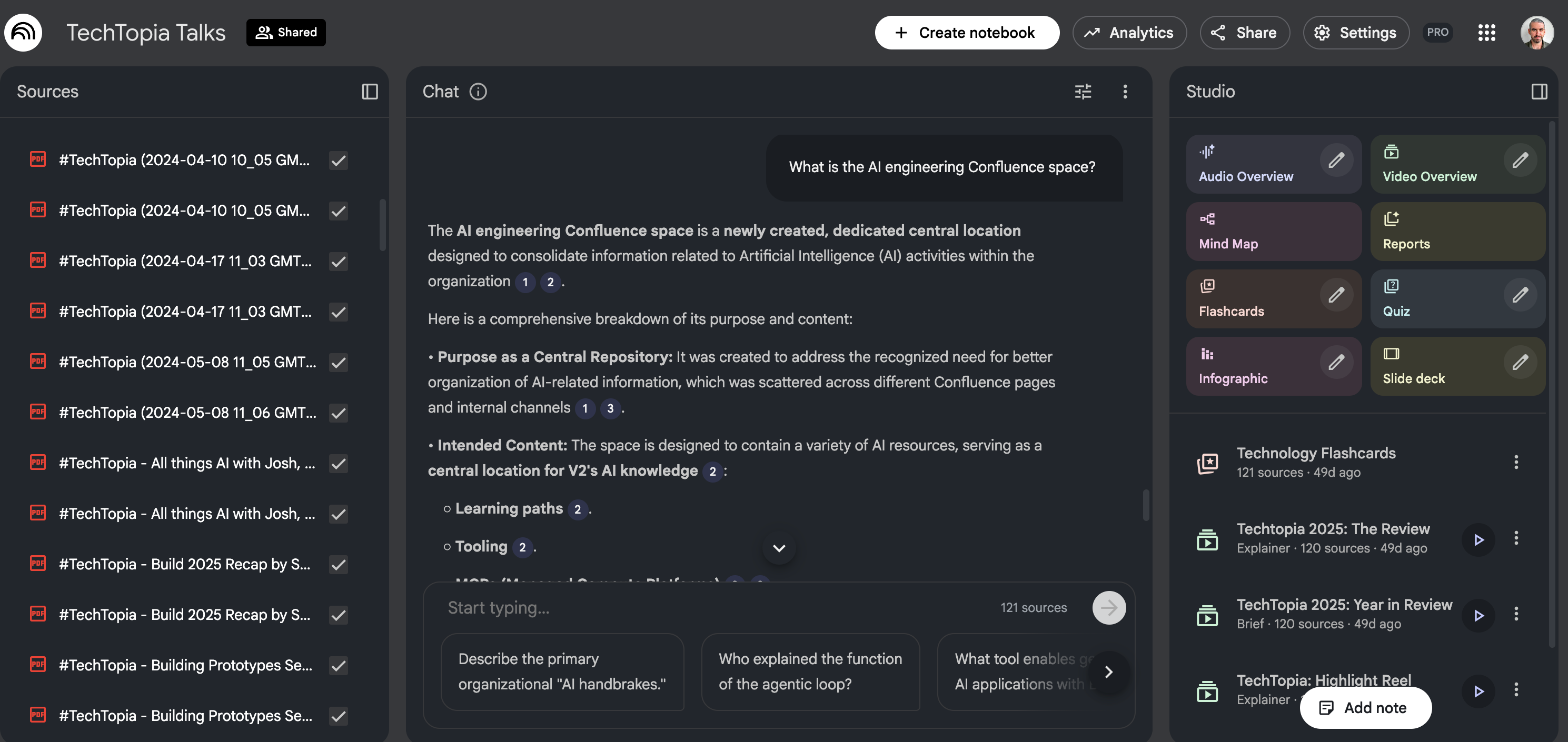
Example Knowledge Repository in Google NotebookLM
AI Agents for Admin Tasks
Every delivery team is often bogged down by mundane tasks such as updating Jira tickets, refreshing README files, or converting code/test results into business user documentation. AI agents can be integrated into delivery workflows to manage these tasks automatically or via manual triggers.
For example, when a developer is writing code to meet a specific feature requirement, they could have AI agents update the code documentation, create a commit with detailed information about the change, and even update the JIRA ticket status.
Instead of someone manually uploading call recordings or docs, an AI agent automatically ingests information across communication channels. Instead of a team member stopping mid-discussion to create a ticket, the AI automatically creates it, organises it, and notifies the right people. It also sends daily reminders, checks due dates, and updates schedule fields on request.
Delivery teams then free up time to focus on higher-value activities such as managing delivery risks, identifying opportunities to unlock new value, and progressing the creative and complex elements.
AI-Enabled Discovery
AI can bring a new level of speed and creativity to early-stage design. It can compress the prototyping cycle while also reducing the risk of rework downstream.
An AI agent that knows the preferred UI/UX experiences in your team rapidly iterates brand-aligned prototypes in real time. Your team can use it as a collaborative thinking partner, sharing requirements and getting it to explore multiple design directions within the boundaries of your existing design assets. It tests assumptions and refines concepts, bringing ideas to life in ways that resonate more strongly with stakeholders.
For example, the AI generates multiple screen recording videos showing different ways a new feature can integrate with existing app workflows. Stakeholders can experience the feature visually without writing a line of code and tweak it to suit their needs.
This accelerates the entire discovery phase and ensures developers move into build mode with alignment and a stronger sense of what “good” looks like.
AI-Enabled Project Management
The end goal is to have AI agents co-deliver alongside the team. You can think of it as an always-on assistant that ingests all data, manages delivery plans, and keeps work moving without manual intervention.
But beyond this, the AI agent uses reasoning to identify risks early. As it continuously monitors conversations, actions, and plans, it can correlate these moving pieces to flag emerging issues.
For example, if team members mention upcoming leave in chat, the AI highlights a potential resource gap for the delivery lead. If a stakeholder hasn’t responded for an extended period, it warns of a likely delay due to missing information.
Instead of project managers manually chasing weekly updates, the AI automatically extracts signals from team conversations. Blockers, concerns, and workload changes are all covered in concise status summaries. When potential issues surface in real time, delivery leaders get more time to act and far fewer surprises.
How to Achieve this New Reality?
AI-enabled delivery starts with building bespoke agents that embed directly into the tools your teams already use. These agents should have access to Slack channels and email threads, integrate with Jira, and be able to take action.
For example, tagging a delivery agent in a Slack thread should trigger it to automatically generate a Jira ticket, apply the proper labels, and allocate it to the correct sprint. As a digital team member, it creates status reports, delivery summaries, design notes, and other project artefacts from team activity.
For organisations running multiple delivery streams, security and governance are key to scaling such an agentic system. A centralised set of regulated and tightly controlled agents will ensure consistency, governance, and reuse. All compliance requirements should be administered centrally to protect data, while ensuring the agents are available across teams to deliver value. They can operate as shared employees, with context across all projects, powering the organisation’s entire delivery rather than scattered, ad hoc experimentation.
Conclusion
The path to fully AI-enabled delivery is already emerging as teams automate their tickets, summarise updates, and use AI tools and features to handle everyday delivery tasks. The opportunity now is to move from isolated use cases to a model where AI sits at the core of how delivery teams operate.
With the right integrations, governance controls, and experienced human oversight, AI agents can become part of the fabric of project execution rather than an optional add-on.