

TL;DR: With AI capabilities nearing general intelligence, there is no longer any doubt that AI can deliver extraordinary business value across every industry. However, a lack of enterprise readiness is still preventing AI from turning into a native operational capability. This blog explores four key barriers limiting enterprise-scale AI and Databricks solutions to overcoming them.
Over the past two years, enterprise AI activity has increased rapidly, with almost everyone running copilots and chatbots and launching multiple agent pilots. However, only a small number of organisations have been able to redesign business processes around AI and embed it into core operations.
The majority remain stuck in experimentation or task-level automation, with Gartner predicting that over 40% of agentic AI projects will be cancelled by the end of 2027.
The challenge is that enterprise AI depends on far more than model intelligence alone. Organisations have to solve four foundational problems first.
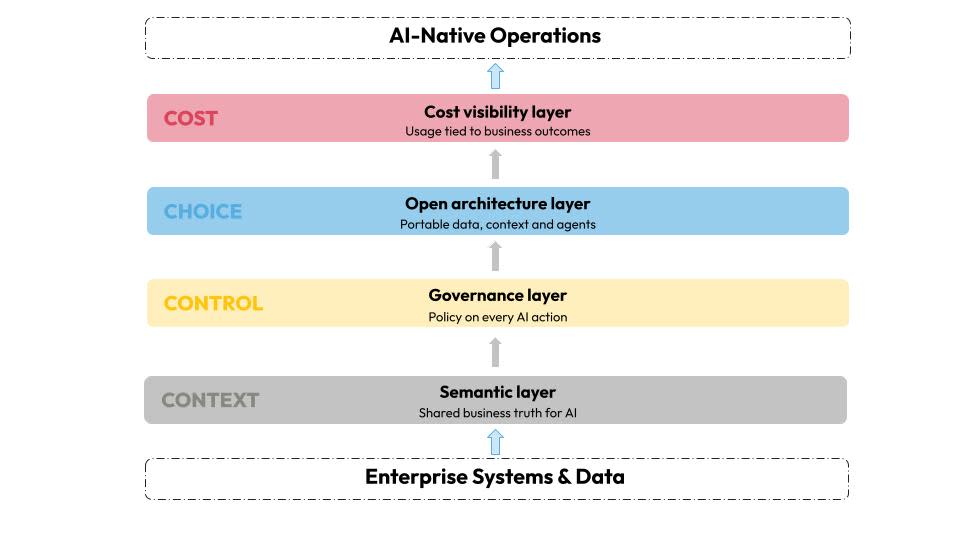
Context: Giving AI Business Understanding
AI systems are only as effective as the business context they can access. Fragmented and semantically redundant enterprise knowledge limits AI’s potential and performance.
Enterprise knowledge is distributed across operational systems, documents, messaging platforms, emails and data warehouses. The same real-world objects and concepts are often expressed using different terminology and conflicting definitions. For example, a policy might refer to an insurance contract for underwriting teams, while legal teams use the same word to describe internal governance documents.
AI systems must understand context to reason correctly, a challenge that compounds when automation spans business functions. Ask three business units for "revenue", and you receive different calculations. Finance reports recognised revenue, Sales refers to bookings, and Customer Success may focus on annual recurring revenue (ARR).
Enterprise Readiness Strategy
Build a layer of trusted truth on top of existing knowledge sources so AI can understand your operations more meaningfully.
Knowledge engineering is becoming one of the most important disciplines in enterprise AI. Rather than forcing AI agents and systems to source and format the information they need, it is more efficient and scalable to build a living semantic layer that connects business concepts, policies, relationships and real-time operational data into a shared understanding of the enterprise.
Databricks' Genie Ontology creates a continuously updated business knowledge layer that allows AI agents to understand not just data, but how the organisation actually operates.
Control: Governing AI Before It Takes Action
Most enterprise governance models assume decisions are made by people. Identity, permissions, audit trails and approval workflows require a redesign to make the switch to human-AI workflows.
Traditional identity and access management systems are built for human users who authenticate once and operate within clearly defined roles. However, AI agents authenticate programmatically, can invoke other agents, and can continue operating long after the user who initiated the task has logged off.
Organisations need to answer:
Who is accountable when an autonomous agent makes the wrong decision?
When should an agent act independently, and when should it escalate to a human?
How do you audit a workflow involving multiple collaborating agents?
Which regulations apply when agents operate across multiple jurisdictions and cloud environments?
Even organisations with AI governance frameworks are grappling with agent sprawl and shadow agents operating outside approved processes.
Enterprise Readiness Strategy
Create a governance layer that controls what AI can do, what it can access, and how every action is monitored and audited.
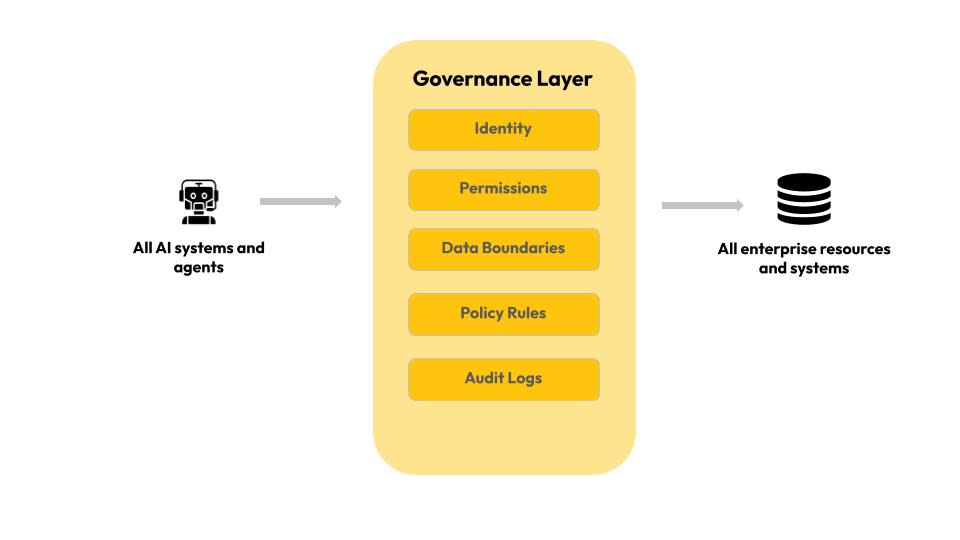
Every AI action passes through the governance layer, ensuring critical policies are applied consistently across the enterprise. Engineers focus on building high-value, business-specific capabilities, while the layer handles repetitive compliance, security, and policy tasks.
For example, the layer can:
Prevent agents from sharing PII or proprietary data outside approved boundaries.
Block harmful, misleading, or copyright-protected content in agent responses.
Codify rules for regulations to prevent violations before they occur.
Databricks Unity Gateway is the example here, sitting between agents and enterprise systems. It enforces permissions, identity, security policies and auditability every time an AI system interacts with enterprise data or external models. It can also shift workloads between multiple models based on cost, capability, and policy constraints.
Choice: Avoiding Tomorrow's Lock-In
AI context is getting locked into various tools across the complicated technology stack that most organisations have. This limits innovation, forces workarounds, and adds to scaling costs.
Keeping AI capabilities embedded directly inside existing enterprise tools limits what you can achieve with the AI solution. At the same time, organisations moving away from copilots and assistants to AI platforms face a new challenge. It's no longer just data, but semantic context, agent logic, and multi-step workflows trapped in a proprietary format.
The more valuable an AI agent or workflow proves, the more expensive it becomes to leave the platform it was built on. Scaling decisions end up being made around vendor economics rather than business needs.
Enterprise Readiness Strategy
Choose an AI platform that keeps your data, business context and AI capabilities portable.
As AI evolves, organisations should be able to replace any component in their AI stack and share AI capabilities without rebuilding applications or migrating data. This requires an open architecture built on open standards, with data, governance, context and AI logic remaining independent of any vendor.
Databricks open lakehouse architecture uses open data formats with capabilities like OpenSharing to extend this principle beyond data. Organisations can securely share AI agents, semantic context and reusable AI logic across platforms and change models without redesigning the entire solution.
By designing for openness from the beginning, you retain the freedom to adopt future innovations based on business value over vendor limitations.
Cost: Scaling AI Without Scaling Spend
AI introduces an inherently variable cost model, compounded by a structural mismatch between how cost is measured and how value is realised.
Business units are deploying their own AI initiatives, yet leaders and board members are struggling to answer fundamental questions:
Which initiatives are delivering value?
Which teams are driving costs?
Which AI investments should be expanded or stopped?
Without linking AI usage to business outcomes, enterprises risk optimising token costs while losing sight of return on investment.
Enterprise Readiness Strategy
Build the measurement architecture necessary to achieve complete cost visibility and to correlate AI usage with business goals.
To scale AI, organisations require a central system that tracks AI spend across users, teams, applications and workflows. It should be combined with budget controls and policy enforcement and correlated with business KPIs.
Databricks' Unity Gateway supports this shift by providing both spend controls and detailed cost attribution.
Instead of treating AI as a black box, finance and platform teams gain the visibility needed to forecast expenditure, optimise model usage and govern AI investment at enterprise scale.
Final Words
Enterprise AI has reached an inflection point. The technology is ready. The question is whether your organisation is.
Close the gap between AI activity and AI value by creating enterprise foundations that enable AI to operate as a trusted, governed, and measurable business capability.