
TL;DR As AI becomes a strategic imperative, the onus is on leadership to steer AI initiatives in the right direction early. Beyond technology decisions, leaders must orchestrate the organisation around learning, safety, observability, and value creation. This blog covers key practices leaders need to adopt to successfully scale AI across the enterprise.
AI technologies have matured and are now capable of impressive feats. The question for leaders is not whether AI initiatives can be launched quickly, but whether the organisation is structurally prepared to absorb and govern that speed.
Embedding AI in internal workflows gives organisations the opportunity to learn and refine before the technology reaches revenue-critical channels. However, AI's progression from an employee assistant to partial and supervised agentic autonomy also requires structural adjustments.
Organisational leaders must attempt to:
Understand external and internal business workflows at a granular level.
Identify where AI can add value without introducing disproportionate business risk; and
Design feedback loops that allow systems to improve over time.
Scaling AI, therefore, becomes a leadership discipline rather than just a technical experiment.
Here are three essential best practices that enable leaders to turn early momentum into sustained advantage.
#1 Create Space for Decisive AI Execution
Leaders must understand both risk and value velocity, and be prepared to solve structural problems, prioritising long-term capability over short-term discomfort.
AI adoption challenges long-standing processes, role boundaries, and cross-team ownership. Decision-making is required more frequently as ideas and concepts move closer to outcomes and business value realisation phases. An innovation function constrained by excessive consensus-building or internal politics will struggle to keep up.
Enterprise AI requires separating exploration from enterprise Business as Usual (BAU) inertia. Otherwise, AI initiatives can spread across groups and stall frequently, resulting in momentum loss before they even begin.
Action
Establish a focused AI team with both technical credibility and business execution authority.
Include technology experts who understand AI capabilities and executives who can influence their direction.
Ensure you get business value from the initiative that you’re focusing on.
#2 Redesign Governance for AI Velocity
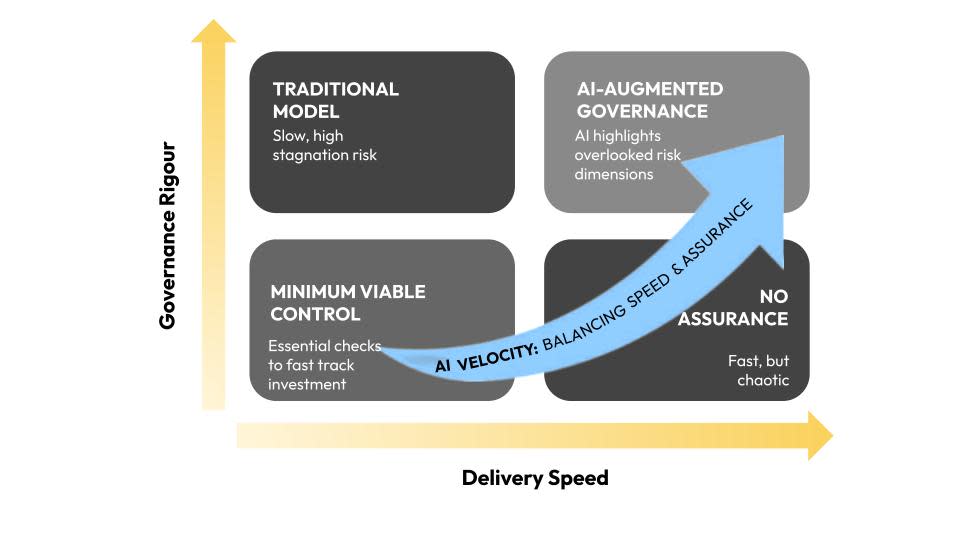
AI Leaders must redesign governance structures to balance speed with assurance, so AI investment decisions are fast but grounded in clear business value rubrics.
Traditional governance frameworks were designed for capital-intensive, multi-year transformation programmes. They rely on detailed forecasting, staged funding approvals, and formal portfolio reviews run through PMOs or EPMOs. These mechanisms remain important, but are not built for the AI era.
The question leaders must ask is whether their current approval model is proportionate to the speed of AI delivery. In some organisations, the time it takes to secure finance approval and pass through portfolio reviews can exceed the time required to build a complete working AI solution. That mismatch either paralyses progress or drives shadow AI innovation outside formal controls.
The answer is a governance mechanism redesigned for AI velocity.
AI introduces risk dimensions that traditional delivery models were never designed to handle. Risks around bias, performance, accountability, and transparency can create unintended consequences at scale and must be embedded into both approval pathways and operating models from day one.
Action
Governance in the age of AI requires clarifying minimum viable control. “What are the essential dimensions that must be assessed before an AI initiative proceeds?”
Introduce a lightweight AI investment assessment framework that focuses on key concerns such as expected ROI, brand impact, competitive response, and regulatory implications.
It should help leaders align initiatives with the broader organisational vision.
If it cannot align, move on to the next idea.
Also, you can consider augmenting your initiative governance with AI. Investing in AI-powered decision-support systems can surface trade-offs and highlight risk dimensions that may otherwise be overlooked. Work with your PMO and EPMO leaders and their teams to govern at speed and scale.
#3 Maintain Assurance Through Measurable Visibility
Leaders must measure and connect metrics across business and technology to ensure AI systems behave as intended and shift the appropriate business metrics without unintended consequences.
Most organisations track KPIs and OKRs at the executive level, such as revenue growth, margin, customer satisfaction, or cost reduction. At the operational level, IT teams track infrastructure metrics, transaction volumes, latency, error rates, and system performance. These layers often exist in isolation. What is frequently missing is vertical traceability between them.
Enterprise AI requires those layers to be connected. For example, if an AI system is automating customer interactions, leaders should understand:
The volume of transactions processed
The cost to serve each transaction
The margin implications
AI resource usage and consumption volumes.
The relationship between infrastructure signals, AI automation, and business outcomes must be made explicit.
Action
Start at the top, with clarity around which business outcomes matter most, and flow metrics downward into instrumentation across systems, data pipelines, and AI models.
Converge your existing observability platforms for your IT systems to your organisational value frameworks and KPIs.
Identify traceability and course corrections to steer towards industry disruption and innovation.
Organisations that rely solely on periodic reporting or manual oversight will struggle to manage the complexity AI introduces.
Final Thoughts
Every significant technology shift introduces a period of adjustment across processes, behaviours, and governance structures. These manifest as J-curves, with initial productivity dips before rapid accelerations. AI is no different. Early friction reflects the effort required to rethink how work gets done.
Long-term gains materialise only when AI is adopted from the grassroots and embedded in real workflows. The people who understand those workflows most deeply are best positioned to redesign them. AI empowerment must extend across the organisation, from senior executives down to field teams. When adoption is broad-based rather than centrally imposed, AI becomes part of how work improves.
Leadership defines guardrails, validates initiatives, and ensures correct visibility and assurance mechanisms are in place. When governance is designed well, it accelerates execution rather than constraining it. Clear decision frameworks reduce rework, increase confidence, shorten approval cycles, and allow teams to innovate within safe parameters. AI then becomes a capability that enhances professional judgement rather than threatening it.
External partners accelerate your transition on the productivity J-curve. V2 AI brings fast-start patterns, governance, assurance, and visibility frameworks, along with new ways of working. We reduce the trial-and-error phase and help organisations avoid common missteps while still preserving internal ownership.
AI scaling in the enterprise is not just about deploying AI models. It is about redesigning leadership systems to support intelligent execution at scale!